How Many Promotional Staff Do You Need for a Successful Brand Activation?
Planning a promotional campaign involves plenty of decisions, but one that can easily be underestimated is how many people you actually need to deliver it. Too few staff and potential customers may walk past without being approached, while too many can leave you spending money unnecessarily. Whether you are organising a product launch, shopping centre promotion, sampling campaign or motorsport event, understanding how to calculate your staffing requirements can make a considerable difference to both your budget and your results.
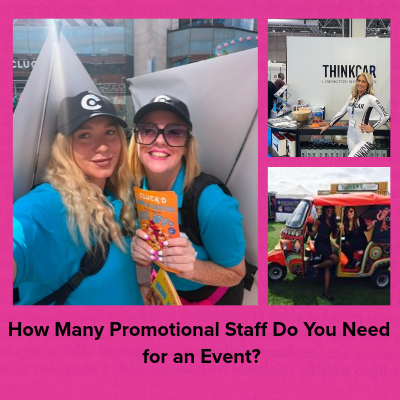
Getting Your Promotional Staffing Numbers Right
When planning a brand activation, it is tempting to start with a simple question: how many promotional staff should we book? Perhaps you have used two people at previous events, or somebody within your marketing team has suggested that four should be enough. While those figures might be perfectly reasonable, they do not necessarily reflect what your campaign actually needs.
The number of promotional staff required depends on several factors, including the location, expected visitor numbers, the type of interaction you want to create and how long each conversation is likely to take. A team handing out promotional leaflets outside a shopping centre will work very differently from staff demonstrating a new product, answering questions and collecting customer information.
Before deciding on numbers, it is worth considering what you want your promotional team to achieve. Are you trying to introduce a new brand, encourage product trials, generate qualified leads or create awareness around a launch? Once you understand the purpose of the campaign, you can begin calculating how many people will realistically be needed to deliver it.
Why Footfall Alone Does Not Determine Staffing Requirements
High footfall is often one of the first things brands consider when choosing a promotional location, particularly in shopping centres, busy high streets and large public events. However, the number of people passing through an area does not necessarily indicate how many meaningful interactions your team can achieve.
Imagine two promotional campaigns taking place in the same shopping centre. One brand is distributing discount vouchers for a new retail opening, while another is demonstrating a household product that requires several minutes of explanation before customers can try it.
Although both campaigns have access to the same audience, their staffing requirements will be considerably different. The voucher campaign may reach hundreds of people relatively quickly, whereas the demonstration team will spend longer with each interested customer.
There is also the question of when visitors are most likely to engage. A shopping centre may experience quieter mornings followed by extremely busy lunchtime and afternoon periods, meaning your staffing should reflect the expected peaks rather than simply the total number of visitors throughout the day.
Understanding these patterns helps you avoid paying for unnecessary staff during quieter periods while ensuring sufficient coverage when demand increases.
How Long Does Each Customer Interaction Take?
One of the most practical ways to estimate staffing requirements is to consider how much time each promotional interaction will involve.
For example, imagine you are launching a new consumer product and expect each demonstration, including answering questions, to take approximately five minutes. In theory, one staff member could complete twelve demonstrations per hour, although that assumes continuous conversations without any time for resetting the display, approaching visitors or dealing with unexpected questions.
In practice, a more realistic planning assumption might be eight meaningful demonstrations per hour, depending on the product and environment.
If your objective is to complete around 200 demonstrations during a six-hour campaign, you would need approximately five promotional staff working at that pace, with appropriate allowance for breaks and other duties.
This is an illustrative calculation rather than a fixed industry standard, but it demonstrates why staffing decisions should be based on the work involved rather than guesswork.
The same principle applies to lead generation. If your promotional staff need to identify interested visitors, ask qualifying questions and record accurate contact details, each conversation requires more time than a straightforward product handover.
Different Brand Activations Need Different Teams
The type of promotional campaign you are running will influence both the number of staff required and the experience you should look for.
At product sampling events, staff may need to prepare samples, explain the product, manage stock and interact with customers. Pitlane Promotions regularly supports Freshpet dog food sampling activity, where promotional teams introduce the product directly to pet owners. In this environment, reaching relevant customers and allowing time for useful conversations can be more valuable than simply distributing the largest possible number of samples.
A motorsport activation presents different considerations. Promotional models and brand ambassadors may be supporting sponsor displays, welcoming visitors, managing promotional activities or encouraging engagement around a vehicle or product launch. Visitor numbers can fluctuate considerably throughout the day, particularly around races and scheduled appearances.
Corporate exhibitions and trade shows introduce another set of requirements, with staff potentially welcoming delegates, managing hospitality, supporting demonstrations and capturing leads while the client’s sales team concentrates on detailed business discussions.
These differences highlight why it is important for businesses to establish their staffing requirements before making a booking. Once you have decided how many people you need and the roles they will be undertaking, a promotional staffing agency can help you source experienced staff who are suitable for your campaign.
The Hidden Staffing Requirements Brands Sometimes Overlook
Even when the main promotional activity has been carefully planned, there are smaller operational requirements that can affect how many people you need.
Staff require breaks, product displays may need replenishing and some activities need continuous supervision. If two people are booked for a busy sampling stand and one takes a break, the remaining person may suddenly be responsible for preparing samples, approaching customers and answering questions simultaneously.
The physical layout of your activation also matters. A large promotional space with several entrances may require staff positioned in different areas, while a smaller demonstration stand could operate effectively with fewer people working closely together.
It is also worth considering whether your promotional team will be responsible for setting up materials, monitoring stock or completing campaign reports, as these activities take time away from direct customer engagement.
Factoring these details into your planning can prevent avoidable pressure once the campaign begins.
Can Hiring Local Promotional Staff Reduce Your Campaign Costs?
For brands planning promotional campaigns across several UK locations, staffing costs can increase quickly if travel and accommodation are included unnecessarily.
Using local promotional staff wherever possible allows you to invest more of your budget directly into the campaign itself. Rather than transporting the same team between cities, you can use experienced staff based close to each activation, reducing additional travel expenses and benefiting from people who already know the local area.
Pitlane Promotions supplies experienced promotional staff throughout the UK, helping businesses source the people they need for product launches, sampling campaigns, exhibitions and brand activations. Whether you require two brand ambassadors in Birmingham or a larger promotional team across several locations, you decide the staffing numbers, roles and campaign requirements, while Pitlane focuses on sourcing and booking suitable local staff wherever possible.
For nationwide product launches or simultaneous retail promotions, this approach can also make it easier to maintain consistent staffing levels across multiple locations while controlling costs.
Finding the Right Balance Between Staffing Costs and ROI
The cheapest staffing arrangement is not necessarily the most cost-effective, particularly if having too few people means your campaign misses opportunities to engage potential customers.
Equally, increasing staffing numbers does not automatically guarantee better results. If there are insufficient visitors, limited space or too little meaningful work for additional staff, the extra expenditure may deliver very little return.
The objective should be to find the point where your promotional team can engage the available audience effectively without creating unnecessary costs.
Before confirming your staffing, consider the number of meaningful interactions you want to achieve, how long those interactions will take and whether your proposed team can realistically deliver them during the available hours.
After the campaign, comparing your planned targets with actual results can help you make better staffing decisions for future activity.
Making Your Promotional Staffing Budget Work Harder
There is no single staffing number that works for every brand activation, because the right team depends on what you are asking people to do and the environment in which they will be working.
The most useful starting point is to work backwards from your campaign objectives rather than forwards from an arbitrary number of staff. Establish how many customers you want to reach, consider the time required for each interaction and account for visitor flow, breaks and operational responsibilities.
The key takeaway is that successful promotional staffing is about having enough of the right people available at the right moments, rather than simply filling positions.
When staffing levels reflect your campaign objectives, you give your brand a better opportunity to engage customers, manage costs and achieve a worthwhile return on your promotional investment.
