Product Sampling in 2026: Why Putting Your Product Into Someone’s Hand Still Works
Brands have more ways to reach consumers than ever before, yet one of the simplest forms of marketing remains remarkably difficult to replace. Giving somebody the opportunity to taste, try or experience a product removes some of the uncertainty that exists between seeing an advert and deciding to buy. For brands considering product sampling in 2026, the interesting question is not whether people enjoy receiving something for free, but whether that first experience can influence what they purchase next.
There is something refreshingly straightforward about product sampling. A brand has created something it believes customers will like, so instead of spending the entire marketing budget telling people how good it is, it gives them the opportunity to decide for themselves.
Consumers now discover products through social media, influencers, online advertising, reviews, search results and recommendations, often seeing the same brand several times without physically experiencing what it sells. Sampling changes that relationship because suddenly the product becomes real.
For food, drink, beauty, pet care and other consumer brands, that moment can be particularly valuable. Marketing can generate awareness and communicate benefits, but sometimes the most persuasive argument is simply putting the product into the customer’s hands.
Why Does Product Sampling Still Work?
It would be easy to assume sampling works because everybody likes getting something for free. While that undoubtedly helps attract attention, the real commercial value is trial.
Most of us are creatures of habit when we shop. We buy the coffee we already enjoy, choose familiar skincare products and pick up the food we know our pets will eat. Even when an alternative looks interesting, changing involves a small risk because nobody wants to spend money discovering they preferred their original choice.
A sample removes much of that risk.
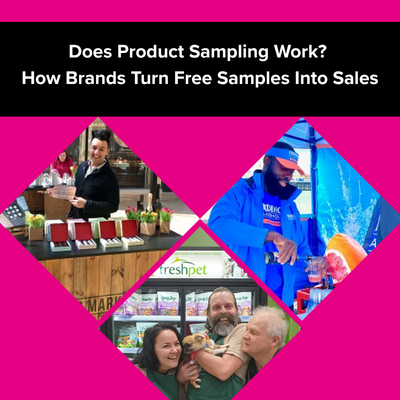
This is something we see whilst supporting Freshpet sampling activity. Promotional staff provide dog owners with Freshpet food samples, allowing potential customers to take the product home and see what their pets think.
The interaction itself may only last a few minutes, but commercially it has an important purpose. A customer who might previously have walked past the product in store has now experienced the brand and, importantly, their dog has experienced the food. When they next encounter Freshpet while shopping, it is no longer an unfamiliar choice.
That movement from awareness to experience is where sampling becomes much more interesting than simply counting how many products were handed out.
Good Product Sampling Is About More Than Distribution
If success were purely about distributing the greatest number of samples possible, brands would not necessarily need promotional teams at all. They could place products somewhere busy and invite people to help themselves.
The value of experienced sampling staff is the conversation that happens alongside the product.
Good promotional staff understand how to introduce something naturally without turning every interaction into a sales pitch. They can explain what the product is, highlight relevant information, answer straightforward questions and encourage somebody to give it a try.
Just as importantly, they understand that every customer is different. Someone walking quickly through a busy event may simply want to accept a sample and continue, while another visitor may be genuinely interested and want to know considerably more.
Experienced staff recognise those signals and adjust their approach accordingly, helping the brand feel approachable rather than intrusive.
The Right Customer Matters More Than the Biggest Crowd
High footfall sounds impressive when planning promotional activity, but the largest crowd is not necessarily the most valuable audience.
A campaign that distributes thousands of samples to people with little interest in the product may look successful on a spreadsheet while generating relatively little commercial value. A smaller campaign reaching consumers who closely match the target market could produce a very different result.
Pet products provide an obvious example. Putting samples directly into the hands of dog owners has far greater relevance than simply choosing the busiest available location and hoping some of those passing consumers own pets.
The same principle applies to almost every sampling campaign. Location should follow the customer.
Instead of beginning with “Where can we hand out the most samples?”, brands can ask “Where can we reach the people most likely to buy this afterwards?”
That small change in thinking can completely alter how a campaign is planned.
How Can Brands Measure Product Sampling ROI?
The number of samples distributed is useful operational information, but it should not automatically become the measure of success.
What happens afterwards matters more.
Did consumers search for the product, visit the website, use a voucher, scan a QR code or purchase it when they next saw it in store? Depending on the campaign, promotional codes, digital offers, competitions and data capture can help connect the physical interaction with later customer behaviour.
Sampling can also support wider marketing activity. Once somebody has physically experienced a product, they may recognise the packaging later, pay more attention to an online advert or remember the brand when they are ready to purchase.
There is another useful source of information too. Promotional staff hear the questions and reactions customers give in real time. If the same question or objection keeps appearing throughout a campaign, that feedback can be valuable to the marketing team.
Taking Product Sampling Campaigns Across the UK
For brands running activity across several locations, using local promotional staff can make a nationwide campaign considerably easier to manage.
Pitlane Promotions provides promotional and sampling staff throughout the UK and aims to use teams local to each activation wherever possible. This avoids unnecessary travel costs and means brands do not need to transport one team around the country simply to maintain consistency.
A campaign can therefore operate across several cities simultaneously, with each local team working from the same brand brief, objectives and key messages.
For businesses planning large launches, retail promotions or multi-location sampling campaigns, that flexibility can make nationwide activity much more practical.
The Real Test Comes With the Next Purchase
Product sampling has survived countless changes in marketing because it does something very simple that advertising cannot always replicate. It lets the customer experience the thing you are asking them to buy.
For the consumer, that removes some of the uncertainty of trying something new. For the brand, it creates a direct opportunity to turn awareness into experience and experience into future purchasing behaviour.
The important point is to look beyond the giveaway. Identify the people you genuinely want to reach, find the places where those customers can be found, brief your promotional team properly and decide what you would like consumers to do after trying the product.
Because the real success of a sampling campaign is not measured when the free product changes hands.
It is measured when that customer sees the product again and chooses to pay for it.
